PORTO BADISCO · OTRANTO
Nature
Porto Badisco and Nature
Porto Badisco, whose name comes from the Greek “batus”, meaning deep, and which was once called Vadisco, holds a heritage of inestimable value: a very delicate ecosystem that shelters particular species, extremely rare and endangered. Many of these plants have parts that contain active principles (drugs).
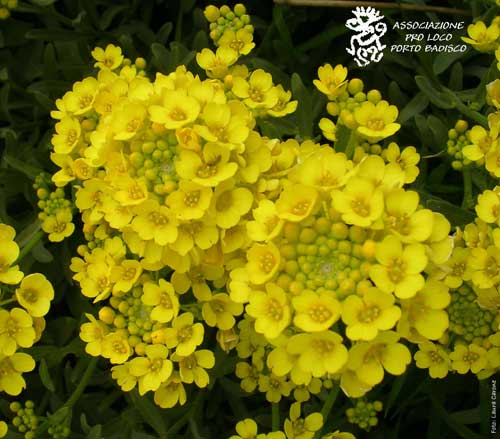
Leuca alyssum (Alisso di Leuca)
Alyssum leucadeum
Description: a perennial species, woody at the base; it grows among the rocks. The plant can reach 40 cm in height.
Leaves: lanceolate, a lovely glaucous green, covered in dense down.
Flowers: small, gathered in racemes of a bright, lively yellow.
Flowering: it blooms in spring. After flowering the plant enters a summer rest period, in step with the climate of the area where it lives.
Location: it grows on the Salento peninsula (as its name suggests).
Status: included in the national red list.
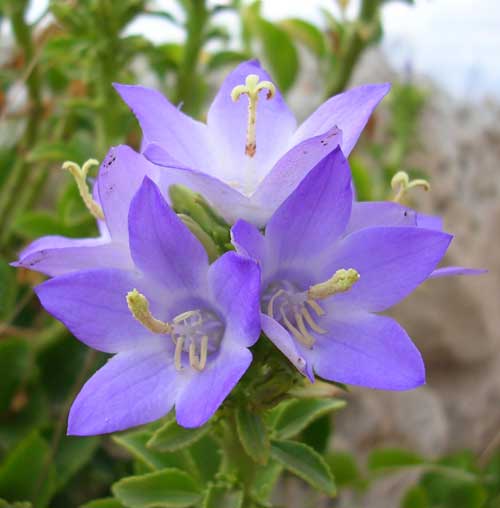
Apulian bellflower (Campanula pugliese)
Campanula versicolor
Description: a member of the bellflower family (Campanulaceae), a hairless plant up to 40 cm tall, with erect or ascending stems, simple or branched.
Leaves: leathery.
Flowers: in clusters, with five triangular lobes, pale violet or sky blue.
Flowering: between June and October.
Location: its habitat is among limestone cliffs; it is typical of the Salento rocky coasts.
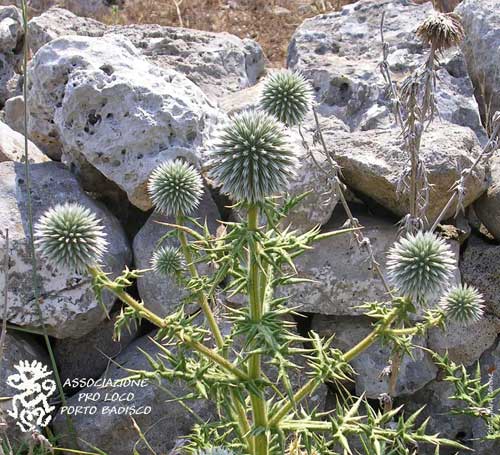
Sticky globe thistle (Cardo pallottola vischioso)
Echinops spinosissimus
Description: a genus of seed-bearing plants in the Asteraceae family, looking like annual herbs with the typical ball-shaped flower head and rhizomatous roots.
Leaves: arranged alternately along the stem.
Flowers: tubular.
Distribution: rocky, wild places.
Uses: the raw material for a chewing gum called “Mastice Anagado” is extracted from it.
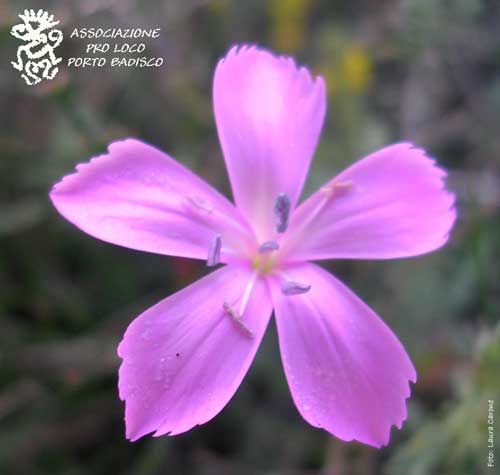
Apulian pink (Garofanino pugliese)
Dianthus japigicus
Description: the stems can reach 80 cm in length. It has a woody root, with long stems ending in 5–6 flowers of a lovely pink colour.
Distribution: found on sea cliffs.
Flowering: between June and September.
Alongside the native flora, the Mediterranean scrub that dots our coast is important.
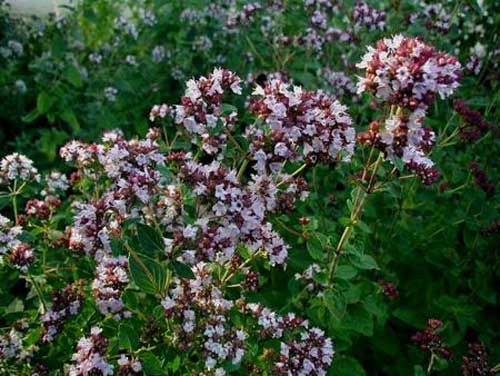
Oregano
Origanum vulgare
It has erect, reddish stems 25–85 cm tall. The leaves are opposite, stalked, green on both sides, entire and with large, barely marked teeth. The flowers are purplish, rarely white, and fragrant. The fruit is a tetrachene. It is an aromatic plant widely used as a spice in many dishes.
The flowering tops are used; they contain the essence, rich in carvacrol and thymol. It is used as a stomachic and antispasmodic, and as a seasoning.
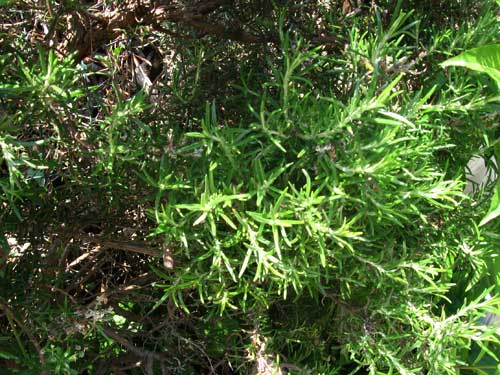
Rosemary
Rosmarinus officinalis
It is a bushy, evergreen, much-branched shrub 1–2 m tall. The leaves are sessile, narrow and entire, with strongly rolled-back edges, green on the upper side and whitish underneath. The flowers are blue or lilac and arranged towards the tip.
The drug consists of the flowering tops and the leaves, which have branched covering hairs and secretory hairs. The essence has stimulating and antispasmodic properties and is useful in atonic dyspepsia and stomach pain; externally, thanks to its tonic properties, it is used in preparations such as ointments and lotions.
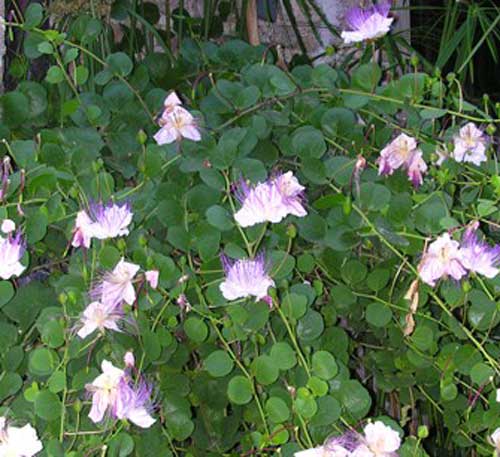
Caper
Capparis spinosa – Fam. Capparidaceae
A herbaceous plant with green leaves, generally alternate, with entire margins. White flowers with numerous stamens and long red-violet filaments. The fruit is a berry, first green, then reddish. It is used as a digestive, a stimulant and an anti-uric agent.
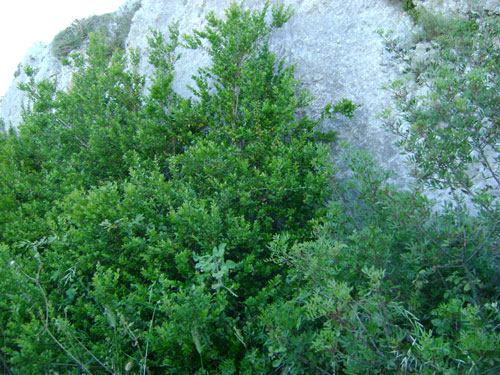
Myrtle
Myrtus communis
A member of the Myrtaceae family, it is found across the Mediterranean region, especially along the coasts. It is a typical species of the Mediterranean scrub.
Botanical characteristics: an evergreen shrub 5–25 m tall, with pinkish bark and opposite branches. The leaves are opposite, elliptical, with entire margins. The flowers are white, fragrant and solitary, with a corolla of 7–8 white petals. The fruit is an ovoid berry.
Drug: the essential oil is obtained from the leaves; polyphenolic compounds such as tannins and flavonoids are obtained from the berries.
Pharmacological activity: the essential oil has balsamic, sedative and antiseptic properties thanks to myrtol. Flavonoids have anti-inflammatory, anti-allergic, antithrombotic and vasoprotective properties. Tannins have astringent properties.
Uses: the liqueur industry; the dried leaves are used to prepare distillates.
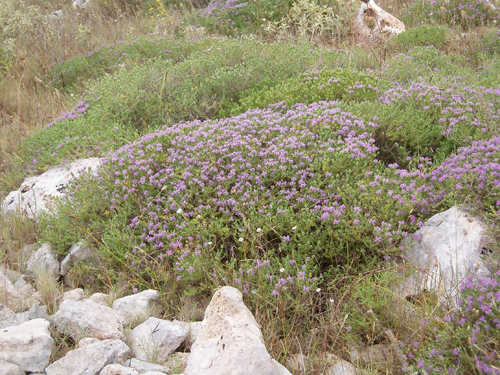
Thyme
Thymus vulgaris
A perennial plant with erect, woody stems 20–30 cm tall that form green or greyish-white tufts. The leaves are small and linear. The pink flowers are gathered in spikes. The drug consists of the flowering tops and the crushed leaves. It has a strong, penetrating smell and an aromatic taste. The essential oil contains phenols, mainly thymol.
It is an excellent seasoning. It is used as an antispasmodic in whooping cough. It is a vermifuge, an antifungal, an antibacterial and an antiviral.
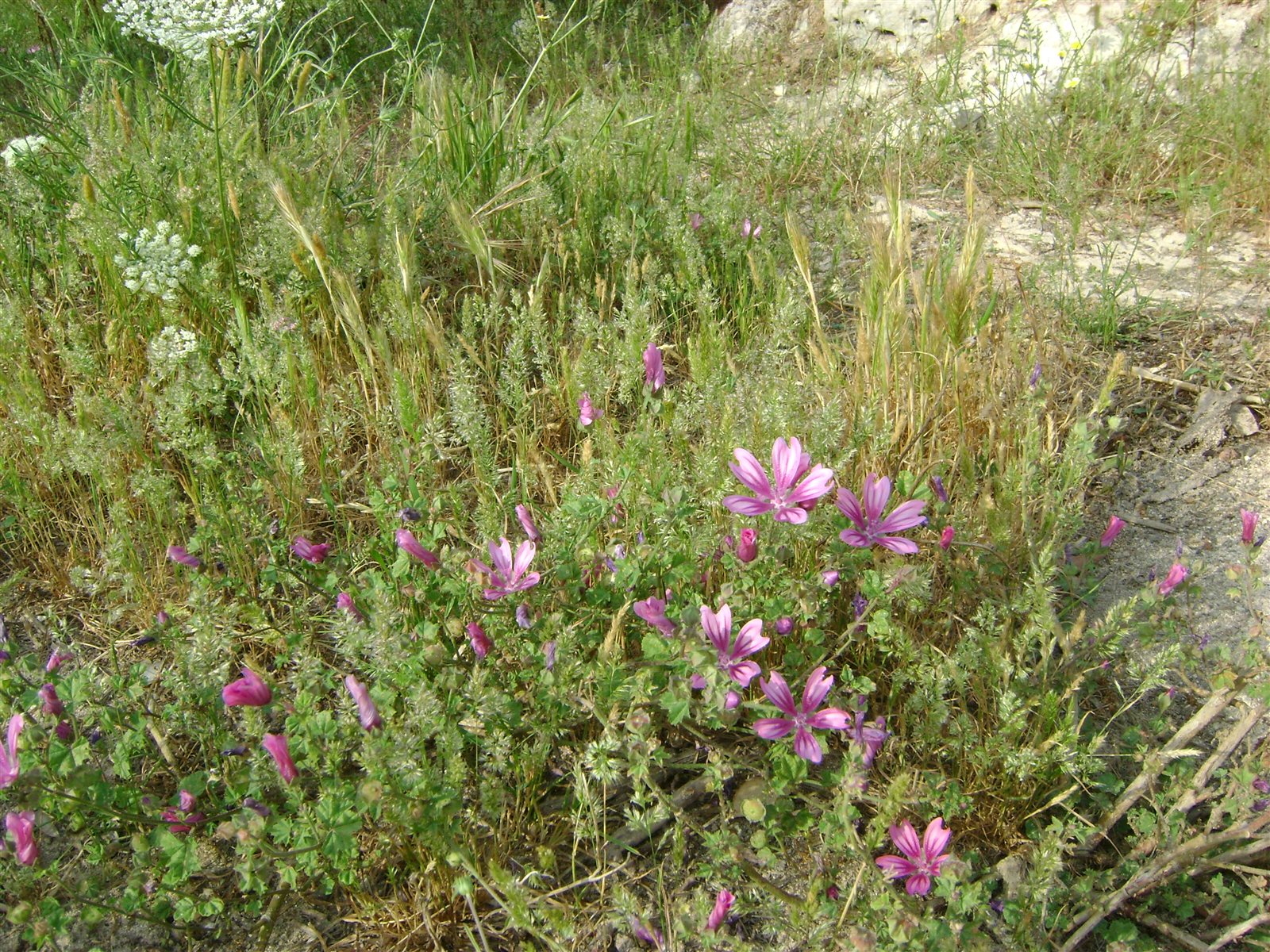
Mallow
Malva sylvestris
A biennial or perennial herbaceous plant, common in dry, stony places. The upright, branched stem bears palmate leaves. The flowers are very large (2.5–3 cm); the violet corolla has darker veins.
The drug consists of the flowers and leaves, rich in mucilage, which are used for catarrhal conditions of the upper respiratory tract. In folk practice the fresh juice was used to soothe insect bites, while the root was given to children to ease swollen gums.
Historical notes: since antiquity the followers of Pythagoras held this plant sacred, because its flowers face the sun. Mallow, whose name literally means “to soften”, was used for its soothing effect on the stomach. Mentioned by Pliny and Cicero, it was used by the ancient Romans as a vegetable or as a side dish for meat.